What’s Next?

Posted June 17, 2008 by Larry Thompson
Categories: Letterpress printing

Last Saturday I had a visit from a fellow letterpress printer and book collector. In honour of this occasion, I cleared off my press, removed the plywood tabletop that spans it and began to set about planning the next project, which is, ironically, much the same as the last one. Well, at least the type is the same. The Vampire story was originally composed for the Ottawa Press Gang collaborative project, and I still need to contribute a piece. So the plan is to run the same type, but this time on one long sheet which will be accordian folded, as opposed to being done in signatures. I had completed the dummy and laid what type I have down on the press, cut the paper I’ll be using and taken some dry proofs when my friend arrived, and then the balance of the afternoon was spent talking about and looking at books. Life is good.

Summing up

Posted June 11, 2008 by Larry Thompson
Categories: Uncategorized

Back again, after another month-long break from blogging. Part of this is thanks to an idle press, a heavy work-load, freelance assignments etc. Whatever the case, I should wrap-up the Vampire chronicles by saying a few words about the text.

About a year ago, the Ottawa Press Gang planned a collaborative project, the theme being fairy tales. After much searching in vain for a piece that was a) in the public domain, b) short in length and c) even mildly interesting, a friend loaned me a collection of Russian folk tales. Most of these were pretty conventional, translated first from the oral tradition and then into English, but after reading the lot, I seemed to have absorbed the style, language, and beat of these tales, so I sat down and wrote my own. Then I decided to print an edition separate from the collaboration.

After finishing it, I realized I had written a classic ’slayer’ tale, much in the mold of Jos Whedon’s Buffy the Vampire Slayer: a problematic young woman with special innate powers taking matters of a vampire infestation into her own hands with a combination of smarts and courage. Sounds like Buffy. So credit where credit is due: the book is dedicated to that most unlikely vampire slayer, Buffy, and her gang, the Scoobies.

Production

Posted May 5, 2008 by Larry Thompson
Categories: Uncategorized

Printing V&7thD was a hard and physically difficult slog. At shows and at ease, when talking to people about the joys of letterpress, I never seem to remember the swollen feet, aching right arm and being generally sore all over. The motion of cranking the drum up and down is neither natural nor ergonomic, and after I had finished printing, I began to notice my hip occasionally giving out under me, not enough to fall but still unnerving (pardon the pun). A trip to the chiropractor has fixed the problem.

After printing the text that I had set, I had to dis two paragraphs, then a third, to gather enough type to finish the job. If this had been the only print run of these forms, I wouldn’t have been so sulky about it, but as it stands, I’m going to have to dis this type, re-set the three paragraphs again for the Press Gang edition, dis that and re-set the ending. Does any of that make sense? No, not really. I may edit the story down to avoid it entirely. We’ll see.

On Monday, I set the remaining two paragraphs and measured how much space it too up on the last page. I had miscalculated the length. I thought I would have several lines left at the end of page five. In the end, it fit perfectly, using the full 30 lines available. As I’ve said before, I’m a lucky guy….

Printing proceeded at a blistering pace over three or four days. That is too fast; it opens the door to all kinds of mistakes, particularly typographical errors. While the V&7thD seems so far to have been spared the indignities of a typo, these things have a tendency to rear their ugly heads later on. In retrospect, it was a terrible risk, but it paid off in the end. Like I said: lucky guy.

Come Tuesday, with the Grimsby Wayzgoose only five days away, with just three days to complete the work, a note of panic crept into proceedings, and crack began to show in my foundation. In the mad rush I forgot to identify the Greyweathers Press imprint on the copyright page, which meant a final extra press pass at the end of production, but I did manage to remember to place the author’s name on the title page, just before starting the main run. It’s important, because credit doesn’t appear anywhere else.

On Wednesday, I inked up the press in red, cut the drop “O”, and began the run, but it disintegrated after about 25 impressions. There just wasn’t time to worry about it or cut another block. In the end, I’ll probably have a magnesium plate made to finish off the run. Later, I cleaned the press, inked up in a very, very dark blue oil based ink to print the cover page labels. After this, I bound up a prototype.

Overall, V&7thD remains an experience in which I learned much, and in a few spots it shows in the work. Otherwise, I am very pleased with the results. As a concept piece, I’m very happy with the design, even if I’m hung up on print quality. It never ceases to amaze me how the type appears so differently under different light.

Type and paper

Posted May 5, 2008 by Larry Thompson
Categories: Uncategorized

During production of V&7thD, entire mornings would vanish in a flurry of proofs in an effort to achieve the perfect impression. I add ink slowly to the press because I have read again and again how the common error amongst novices and apprentices is over-inking. So while I build up the ink on the press, I proof read each test proof again, looking for those elusive typos. Multiple proofs also seems to help ‘train’ the packing around the drum, which may still carry the faint impression from a previous press run. Finding the best impression is like searching for the Holy Grail, occasionally the Monty Python version. The good news is that corrections on the press are down significantly from previous projects, meaning I’m becoming more accurate as I set type. For the gothic type I used Goudy Text, a very beautiful blackletter font named after its designed, who also, as it happens, designed our house font, Italian Oldstyle. Considering I bought this font used and it looked like hell in the trays, it printed almost perfectly. I’m staring to warm up to blackletter in spite of my better judgment.

It was terrifying printing on expensive paper, but the Arches Text Wove is very forgiving, and just while I was printing I could feel the difference: the work felt richer. Like a lot of fine papers, stuff sticks to it. During collation, I notice that several sheets (the one with the cover page etc) had bits of grease on the edges picked up from the press somewhere. Very frustrating, and difficult to fix, page by page, individually.

Judging the book by its cover

Posted May 4, 2008 by Larry Thompson
Categories: Uncategorized

Still working backwards through production on the Vampire story, we come to the cover. Black stock seemed appropriate, in spite of the fact that I used the same on the last book, Tenebrismo. Ah well. The overall pleasing proportions of the pamphlet and the cover are really a credit to Holly’s impeccable design and artistry. It was her idea to paint the paper labels to be pasted to the cover in vivid red swirls, and this stands out like a raw slash on the deep black cover.

The paint on the label sealed the paper, so I had to change up to an oil based ink (one that oxidizes, or dries in air) to print the labels. Oddly enough, I used a very dark blue ink, so dark, it appears black. The deep blue has a kind of richness to it. That, and the Goudy Text blackletter type I used printed perfectly over the smooth, sealed surface. Now why can’t I get it to do that on handmade paper? I had to letter space the Goudy text. Clicking on the three proofs below will serve to demonstrate the nuance of type. In the first proof on the left, set without letter spacing, the very expressive capital V is seated quite far from the adjacent lower case ‘a’. You have to imagine both letter as being solid block of lead founded with precision and right angles. As you can imagine, letters such as V and W can become problematic. In the second proof, I added a very little spacing between the letters, and the third proof is the final proof prior to printing onto the painted labels. The correct action at this point would be to cut away lead from the body of the type — mortise the V and cut down the ‘a’ so that they nest together. I had neither the time nor the inclination to do this, and hoped that letter spacing would do the trick. Letterspacing is normally done when using all capitals. Since Goudy Text is a chunky blackletter face, and seeing that it was such a large face to begin with, it wasn’t far off all caps. And it worked. If anything, I should have spaced the letter a bit more, but it works well as it stands, I think. I applied the first cover label with PVA (white glue) and even with weight on it, it still made the thin cover stock cockle. So I turned to glue stick, which works much better. I’m not certain how archival it is, but it doesn’t warp the cover. I bound this edition up, thinking it would be consigned to exist forever as my demo model, however, an eminent Canadian bookbinder at the Wayzgoose didn’t seem terrible concerned about it, and bought it. It makes me wonder if I fuss to much over tiny things. Naw. I fuss just enough. I like the Mohawk cover stock, but sadly the variety with the nice decal edge has been discontinued. I may change the stock in mid run, and that of course will create the need for an erratum for the colophon. (Now that’s the kind of phrase you really want someone to walk in on in the middle of a converastion! “Oh dear, I’ve got an erratum in my colophon.”) Endpages remain a challenge. I began using a quite vibrant red and blue marbled paper, then used some red paper and now I’m into some orange tissue. I like them all, but I think I will eventually settle for the first, deep, blood red paper or tissue of a fine grade that I can fine. The binding is a simple single long stitch, using red thread to tie it together.

The 30th Annual Grimsby Wayzgoose

Posted May 2, 2008 by Larry Thompson
Categories: Letterpress printing, Shows

It’s been a while, and I think my blog voice is a bit rusty, but here goes. Over the next few blogs, I’m going to report on the final production of the latest letterpress project from Greyweathers Press, The Vampire and the Seventh Daughter (V&7thD), working backward from the launch.

First, the background. A week ago Thursday, April 24th, I sewed up four copies of V&7thD and packed them up for the Wayzgoose. On Friday, Holly and I piled everything and ourselves into the Mini Cooper and hit the road for Grimsby, a scenic town located about 20 minutes past Hamilton on the Niagara Peninsula. The Grimsby Library and Gallery has been home to the Waygoose Book Arts show and sale for 30 years, ever since letterpress veteran Bill Poole of Poole Hall Press established it to give fine press printers a venue to sell their work and to visit with each other. The term ‘wayzgoose’ is an old one, and there are a plethora of reported origins. Whatever the case may be, it was a gathering of printers and related trades (paper makers, bookbinders, type casters, etc.), mainly to have a big party, an activity at which printers have been known to excel.

There. That’s the background.

How can I describe the Wayzgoose? When writing about the antiques business, I would refer to this type of show as a ‘table’ show, meaning exhibitors rented tables and spread their wares over them, as opposed to the more involved booth show, where exhibitors set up hard walls and pedestals for display. Table shows are easy to set up and quick to tear down, so it makes for a good experience all round.

To say that a table show is easy is not to say it’s cheap. Some table tops contained some exquisite examples of fine press and bookbinding amongst other treasures. Take for example George Walker’s latest work, Book of Hours, a wordless novel in 99 wood engravings telling the very personal, very ordinary stories of workers beginning their day right up to the moment the first airplane hit the first tower on September 11, 2001. At $1,000 per copy, I don’t expect any of the ten copies to remain available long. George sold one at the show.

The Wayzgoose enjoyed strong attendance for most of the day, and all the vendors enjoyed hors d’oeuvres and a delicious dinner together afterwards. Very civilized.

As for V&7thD, all four of the bound copies I took with me sold, so I’m happy about that. I’ve sold another since. The book and its topic seem to be popular with artists and those with some goth in their make-up. Holly sold most of the notepads she made prior to the show. They were like miniature paintings!

Launching The Vampire and the Seventh Daughter

Posted May 2, 2008 by Larry Thompson
Categories: Book Launches, Books, Letterpress printing

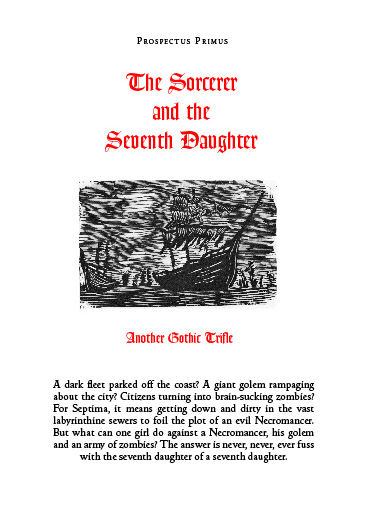
On Saturday, April 26, Greyweathers Press launched its latest letterpress work, an original short story by Larry Thompson titled The Vampire and the Seventh Daughter. This gothic trifle is hand printed with cold type, using our house font, Italian Oldstyle, for the text and the blackface type, Goudy Text, for the cover, title page and opening lines of the story. It is illustrated with five linoleum cut illustrations, and it has been printed in a limited edition of 75 on Arches Text Wove paper from France, with black Mohawk Ultrafine for covers. Cover label hand painted by Holly Dean. Every book is protected from vampires by a tiny cross bound into the front cover.

The Vampire and the Seventh Daughter is pamphlet bound, 8 pages long. $60 per copy plus GST in Canada and shipping. To purchase email Larry Thompson at studio@greyweathers.com or call (613) 269-3714. For more information go to www.greyweathers.com


Ready to Print

Posted April 9, 2008 by Larry Thompson
Categories: Letterpress printing, Paper

You may recall in an earlier post that I decided to do a split run (technically two editions) of the Vampire and the Seventh Daughter: fifty copies on twelve pages 8.5×5.5″ for the Press Gang collaboration, and 50 (or maybe 75) on very fine paper in a larger configuration. I’m pleased to report that 80 sheets of Arches Text Wove arrived last week, so I’m proceeding with the tall edition first. It costs around $2 per sheet, so I’m still recovering from the stress of cutting it down to the page size for the fine edition (!2″ x 13″, when folded creates a page size of 12″ tall x 6.5″ wide).

Well, I say cutting in the technical sense. I decided I liked the rough edge, or decal, on the paper, so I will be printing this job without a trim cut, or a 1/4″ cut around the entire sheet. Since that was the case, I thought, and since letterpress is for masochists, I chose to score, fold and tear sheet by precious sheet the entire supply by hand. Measure twice, cut once indeed! It worked out pretty well, although custom measuring and cutting 80 does not produce the accurate results of the swift stroke of the guillotine, any irregularity should be (hopefully) insignificant, and the end result pleasing.

Part of letterpress is the sensuality of the medium, and paper is a big part of that, as I blathered on about in a previous entry. I first encountered Arches Text through Holly, since this rag-based cotton paper is beloved by calligraphers for its evenness, and yet still possessing an agreeable tooth, which makes it feel like one is holding felt. I’ve never printed on it before, but I expect the same qualities to make it golden for letterpress. Although Arches sells it as ‘white’, it really has a beautiful cream colour. In this age of hyper-bleached paper, that alone endears me.

So with the stock ready, yesterday I drew up my page masters. These are the key to the entire print job, since they supply the specs, page dimensions etc. that take the dummy and transform it into something, well, if not real, at least less abstract than the dummy.

I have no idea why WordPress doesn’t put a blue border around my thumbnails, but if you click on the one at left, you can see a good-sized image of the dummy on top and the page master on the bottom. Lewd innuendos aside, they form the crux of the printing of a book, or pamphlet in this case. All that’s left is to cut a quantity of scrap or rough paper to use as proofs, and I’m ready to go.

The dummy at the top was made from proofs pulled early of both the text and illustrations. The bits are held on (not very well) by Scotch Tape. This is the only time I miss the waxer we once used on layout. The dotted lines on either side of the text block in the master at bottom signify the extent of the form. The text block is the province of the compositor, and while might measure 20 picas, but he has a quad (em space) at the beginning and end of the line, making the width of whole form 22 picas, which is what concerns the printer as he plans the makeready on his press. Being both the compositor and the printer does resolve many issues.

Another thing WordPress has changed in this latest interface change is the removal of the word count, which means I’ve prattled on ad nausium. Therefore, salut!

Back at it.

Posted April 4, 2008 by Larry Thompson
Categories: Letterpress printing

Well, I’m not proving to be much of a blogger. My only excuse is that I have been off writing away for pay, an article on antique iron for the next issue of The Upper Canadian, due out next month.

But all the while I’ve been thinking about printing. When I last blogged on the vampire fable project, I had the type set and lino blocks settled. Since then, I have justified the text, meaning that I spaced the words on each line so that the text block is even on the right side, as opposed to ‘jagged right’. Like everything in letterpress, justification is a bit of a chore. For me, it was like learning to set type all over again. Here’s an illustration of how it works:

set-up.jpgHere is the set up I used for justification. Since the work of compositing type had already been done, I didn’t need the type trays out. On the left are larger spacers: quads or em spaces, 2 em, 3 em and large spacers, 2 to em and 3 to em.  In the crappy little plastic cabinet are the smaller spacers: 4 to em, 5 to em, 6 to em, brasses and coppers. The brasses and coppers are micro thin, and a great aid to tightening up a line of metal type. Nevertheless, even slight difference in the distance between words can be perceived easily by the eye, so the challenge in justifying type is to make the word spacing equal right across the line.

The first job is to transfer the line of type from the tray to the compositing stick and pull out spacing material at the end of the line. If there is a fair gap of space at the end of the line, I ‘knock down’ the standard 3 to ems that I use for word spacing, as shown:

stick.jpg

 Now, an experienced compositor will measure the remaining gap of space, subtract the 3 to em width multiplied by the number of spacers required in the line, divide the whole by that number and then slot in the correct combination of spacers to arrive at perfect justification. Oh, and she’ll do this in a microsecond, in her head.

Naturally, this is not the way I did my justification. Instead, I spent hours and hours frigging around with spacer until it worked out. It probably took as long as it did to set the type originally. But by the end, I began to see how the combination of spacers worked together to create every size imaginable, and the light shone through a little bit. But I’ve yet to have that epiphany moment. Justification is a trick I’ll have to master eventually, but I’m pleased with this first effort. Hopefully it will look right on the final product.

This afternoon, I will break the columns of text into pages with gaps to accommodate images (to be printed separately) and cut paper. Tomorrow, press work.

Searching for my Outer Blood-sucker

Posted March 20, 2008 by Larry Thompson
Categories: Block Printing, Lino Cuts

The saga of the Vampire and the Seventh Daughter continues, with all my energy focused on the final, largest and central illustration of the work. In an earlier blog, I illustrated one attempt at the main image, and said that I had decided against it. Never assume that I am telling you the truth. Actually, you should apply that rule to most everyone.

I spent precious time exploring other avenues, as shown:

sketch1a.jpg

Same idea as the image found on the web, but further efforts with it proved unsatisfactory.

sketch2.jpg
Nope.
sketch1b.jpg

Back to the sketch book, with a view to creating an image that would suffice for both the short wide edition and the tall thin edition. I may revisit this image, or something like it, for the deluxe version. So, back to the beginning.

main-orig.jpg

This is a proof finished off in Photoshop and printed on-piece on a laser printer, so that I could do a proper acetone transfer to the block, resulting in

main-block.jpg

The cut block

main-final.jpg

The final product, although there are some subtle bits of cutting that still remain to be done. I owe Holly big-time for this. I had almost given up on a ‘first page’ image at all, save for her timely intervention, and it all came together.

Speaking of tweaking, to follow up from the last blog entry, I had to redo one of the small 2″ images that I am calling ‘vampire bites’. This one, the neck bite, worked out much better, as these blocks usually do when I have to do them over again. Like the main image, I had to go through a bit of trial and error to arrive more or less back where I started, only with results.

neck.jpg

My original effort. Some could not identify it as human on first view, always a bad sign. Another said it looked very muscular and masculine.

neck2.jpg

Another attempt that, while unsuitable for the project, I still like very much as an abstract.

neck1.jpg

Again, the style doesn’t suit the project, but I like the expression of the piece, and may end up using it for something else.

neckfinal.jpg

And the winner is, this one. A reverse take on the first attempt, this time clearly human and distinctly feminine.

Illustrations are more or less sorted out. Now back to the text and the type.